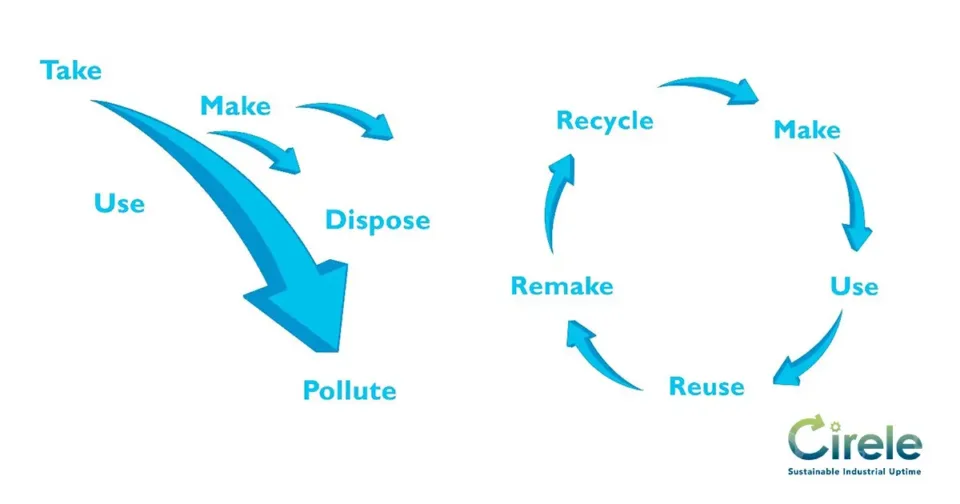
When industrial electronics fail, a decision has to be made quickly. Should you choose PLC repair, buy a refurbished PLC, source a used Siemens HMI, arrange variable frequency drive repair, or replace the part with a new alternative?
For a maintenance manager, technical buyer or plant manager, this is not a theoretical decision. It directly affects downtime, lead time, cost, risk, software, parameters and machine reliability. Choosing the wrong route can result in extra engineering, longer downtime or a machine that still does not function correctly after replacement.
Cirele supports maintenance departments and factories with industrial electronics repair, refurbished supply and new supply of PLCs, HMIs, variable frequency drives, servo drives, power supplies, I/O cards and communication modules.
In this decision guide, you will learn when repair is usually the best solution, when refurbished supply makes sense, and when new replacement or retrofit is the better long-term option.
Common Faulty Industrial Electronics
In factories and production environments, control and drive components are often critical. These parts are directly linked to machine operation, process control, communication or motion.
Common faulty industrial electronics include:
- PLC CPUs;
- PLC I/O cards;
- HMI panels and operator panels;
- touch panels;
- variable frequency drives;
- servo drives;
- power supplies;
- communication cards;
- safety modules;
- motion controllers;
- industrial PCs;
- encoder cards;
- soft starters.
Components containing software, firmware, programs or parameters require special attention. Replacing a faulty PLC, HMI or drive is often not as simple as removing the old unit and installing a new one.
Important Industrial Automation Brands for Repair and Replacement
Cirele works daily with industrial electronics from widely used brands in manufacturing, machine building and process industries.
Important brands include:
- Siemens
Examples include SIMATIC S5, S7, ET200, SINAMICS, SIMATIC HMI, TP700, TP1200, MP277, 6AV, 6ES and 6SL part numbers. - Lenze
Examples include 8200, 9300, 9400, i500, servo drives, frequency inverters and motion controllers. - Danfoss
Examples include Danfoss VLT variable frequency drives, VLT 2800, VLT 5000, FC series and VLT AutomationDrive. - ABB
Examples include ABB ACS variable frequency drives, ACS550, ACS580, ACS800 and other drive solutions. - Schneider Electric
Examples include Modicon PLCs, Schneider Magelis HMIs, Altivar drives and Telemecanique components. - Omron
Examples include Omron PLCs, HMI panels, servo systems and variable frequency drives. - SEW-Eurodrive
Examples include Movidrive, Movitrac and servo drive systems. - Yaskawa
Examples include variable frequency drives, servo drives and motion control components. - Bosch Rexroth
Examples include IndraDrive, servo drives, power supplies and motion controllers. - B&R
Examples include PLCs, HMIs, I/O systems and industrial PCs. - Mitsubishi Electric
Examples include PLCs, GOT HMIs, servo drives and variable frequency drives. - Allen-Bradley / Rockwell Automation
Examples include PLCs, PanelView HMIs, drives and I/O modules. - Beckhoff
Examples include industrial PCs, I/O systems, motion control and automation components.
For all these brands, the exact article number or part number is critical. Within the same series, there can be many variants with different firmware, communication ports, power ratings, voltages or options.
Repair, Buy Refurbished or Replace with New?
The right choice depends on the technical situation, part availability and the impact of downtime. Below are the three main routes.
When Is Repair Usually the Best Choice?
Industrial electronics repair is often the best choice when the part is difficult to source, when software or parameters are stored on the unit, or when the machine is older but still productive.
Repair is usually the right option when:
- the part is no longer available or difficult to source as new;
- the machine is still mechanically sound;
- the PLC, HMI or drive is part of an older but productive machine;
- the program, firmware or parameters are stored on the unit;
- a new alternative would require significant engineering;
- the original machine builder is no longer available;
- the software backup is missing;
- the exact article number configuration is important;
- fast restart is more important than redesign;
- retrofit currently creates too much cost or risk.
For older machines, repair is often more practical than full replacement. The machine has been running reliably for years, operators know the interface and the maintenance team understands the line. One defective module does not necessarily mean the entire control system needs to be redesigned.
PLC Repair or Replacement?
The choice between PLC repair or replacement depends heavily on software, availability and risk. A PLC CPU or I/O card is often the heart of the machine control system. If the PLC program is not available, replacement can become difficult or even impossible without engineering.
PLC repair is often the best route when:
- the PLC is obsolete or end-of-life;
- the PLC program is not available;
- the exact part number is required;
- the machine needs to restart quickly;
- conversion to a new PLC platform requires major engineering;
- communication with HMI panels, drives or fieldbus systems is complex.
PLC replacement or retrofit is usually better when:
- the PLC platform is becoming structurally unreliable;
- multiple PLC modules are ageing;
- the software is available;
- the machine is already being modernised;
- future support and availability are becoming more important.
Relevant SEO terms include PLC repair, PLC repair or replacement, old Siemens PLC replacement, Siemens PLC repair and refurbished PLC.
HMI Repair or Replacement?
When choosing between HMI repair or replacement, the software backup, operator interface and mechanical fit are important. An HMI is often more than a screen. It can contain alarm texts, recipes, user rights, communication settings and local data.
HMI repair is often the best route when:
- the HMI screen remains black;
- the touchscreen does not respond;
- the front glass is cracked;
- the backlight is defective;
- the HMI project is not available;
- the panel is obsolete;
- the same size or cut-out is required;
- a new HMI panel requires software migration.
A refurbished or used HMI is useful when the exact same article number is needed quickly. Examples include a used Siemens HMI, refurbished Siemens TP700 Comfort, Siemens TP1200 Comfort, Siemens MP277, Schneider Magelis panel or Omron HMI.
A new HMI or retrofit is better when:
- the project file is available;
- migration can be planned properly;
- the machine is being modernised;
- cybersecurity or software support is becoming more important;
- the old HMI series is becoming structurally difficult to source.
Relevant SEO terms include HMI repair, HMI repair or replacement, used Siemens HMI, refurbished HMI, Siemens HMI repair, Schneider Magelis repair and Omron HMI repair.
Variable Frequency Drive Repair or Replacement?
The choice between variable frequency drive repair or replacement depends on lead time, parameters, motor configuration and application. A VFD may seem easy to replace, but the settings are often specific to the machine.
Variable frequency drive repair is often the best route when:
- the exact type is no longer available;
- parameters are unknown;
- motor and brake data are application-specific;
- communication with the PLC or fieldbus is complex;
- the drive is installed in an older machine;
- a new type does not fit directly.
A refurbished variable frequency drive is useful when production needs to restart quickly and the same article number is required. The defective drive can later be repaired and kept as a spare.
New replacement or retrofit is better when:
- the old drive type is structurally weak;
- multiple drives in the same line are ageing;
- energy efficiency needs to be improved;
- communication or safety functions need to be updated;
- parameters are available;
- conversion can be planned.
Relevant SEO terms include variable frequency drive repair, VFD repair, AC drive repair, variable frequency drive repair or replacement, refurbished variable frequency drive, Siemens SINAMICS repair, Lenze drive repair, Danfoss VLT repair and ABB ACS repair.
Servo Drive Repair or Replacement?
For servo drives, the decision is often even more sensitive than for standard variable frequency drives. Servo systems are linked to positioning, encoder feedback, motion control and complex machine movements.
Servo drive repair is often useful when:
- the servo drive is obsolete;
- encoder settings are unknown;
- motion parameters are not available;
- the machine needs to move again quickly;
- a new servo drive requires software changes;
- the exact same type is required.
New replacement or retrofit is better when:
- the complete motion control system is being modernised;
- mechanical changes are already planned;
- software and parameters are available;
- multiple axes are being upgraded at the same time.
Important brands include Siemens, Lenze, Bosch Rexroth, SEW-Eurodrive, Yaskawa, Omron, Schneider Electric, Mitsubishi Electric and B&R.
Relevant SEO terms include servo drive repair, servo amplifier repair, refurbished servo drive, Bosch Rexroth IndraDrive repair, SEW Movidrive repair, Yaskawa servo drive repair and Lenze servo drive repair.
When Does Buying Refurbished Make Sense?
A refurbished part is often the fastest route when production is down and repair takes too long. With refurbished supply, you receive a tested used component that has been checked, repaired where necessary and prepared for use as a replacement or spare part.
Refurbished supply is especially useful when:
- production must restart quickly;
- repair of your own unit would take too long;
- the exact same article number is required;
- new supply is unavailable or too slow;
- the component is obsolete or end-of-life;
- software or parameters can be transferred;
- your own defective unit can be repaired later as a spare;
- the maintenance team wants to build critical stock.
Examples include:
- refurbished PLC;
- refurbished HMI;
- used Siemens HMI;
- refurbished variable frequency drive;
- refurbished servo drive;
- refurbished Siemens S7 module;
- refurbished Danfoss VLT;
- refurbished Lenze drive;
- refurbished ABB ACS drive;
- refurbished Schneider Magelis panel.
For critical machines, refurbished supply can make the difference between hours and days of downtime.
Used or Refurbished: What Is the Difference?
A used part is not automatically the same as a refurbished part. This distinction is important for maintenance teams and technical buyers.
A random used part may carry risks such as:
- unknown history;
- no functional test;
- wrong firmware;
- hidden damage;
- ageing capacitors;
- defective backlight or touchscreen;
- contamination or moisture damage;
- no warranty.
A refurbished part is intended as a reliable replacement. It has been inspected, tested and repaired where necessary. For industrial electronics, this matters because a defective replacement part can immediately cause downtime again.
For critical machines, a tested refurbished component is usually safer than an untested used part.
When Is New Replacement or Retrofit Better?
New replacement or retrofit is not always the fastest route, but it can be the best long-term solution. This is especially true when a component is structurally weak or when the entire platform is becoming obsolete.
New replacement or retrofit is useful when:
- the component repeatedly fails;
- multiple components in the same line are ageing;
- the machine is already being upgraded;
- safety standards need to be updated;
- communication needs to be modernised;
- cybersecurity is becoming more important;
- software and project files are available;
- parameters are well documented;
- conversion can take place during scheduled downtime;
- future availability is more important than fast one-to-one replacement.
Examples include:
- replacing an old Siemens PLC with a modern Siemens S7-1500;
- migrating a Siemens Comfort Panel to a successor panel;
- replacing an old Danfoss VLT with a newer drive;
- converting an obsolete servo drive to a new platform;
- replacing an obsolete communication card with a modern network solution.
Important note: new is not automatically faster. A new part may have a lead time and often requires engineering, parameter setup, software migration and functional testing.
Decision Matrix: Repair, Refurbished or New?
The matrix below helps with the first decision.
| Factor | Repair | Refurbished | New / retrofit |
| Lead time | Good with urgent repair, depending on fault | Often fast if in stock | Often longer due to supply and engineering |
| Cost | Often lower than new | Medium, depending on availability | Usually highest investment |
| Risk | Low if the original unit is retained | Low to medium, if tested | Technically strong, but migration risk |
| Software / parameters | Major advantage: original configuration may be retained | Transfer may be required | Migration or new configuration required |
| Downtime | Good with fast repair | Very good when immediately available | Less suitable for acute breakdowns |
| Warranty | Cirele offers 2-year warranty on repairs | Depends on supply | Manufacturer or supplier warranty |
| Future availability | Good for extending service life | Good as spare parts strategy | Best for long-term standardisation |
| Best use case | Obsolete or configuration-critical parts | Acute downtime and exact part number required | Planned modernisation |
How Do You Make the Right Choice?
Use these practical questions:
- Is production currently down?
Then urgent repair or refurbished supply is usually the fastest route. - Is the exact article number still available?
If not, consider repair or refurbished supply. - Are software, backups and parameters available?
If not, be careful with new replacement. - Is the part installed in an older but still productive system?
Then repair is often logical. - Does the same fault keep returning?
Then retrofit or modernisation may be better. - Is the machine already scheduled for an upgrade?
Then new replacement or retrofit may be the strategic choice. - What is the cost of downtime per hour?
With high downtime costs, stock or refurbished supply is often sensible.
Practical Example Scenarios
Scenario 1: HMI Fault, No Backup Available
A machine has a defective HMI panel. The screen remains black and the touchscreen no longer responds. The machine itself is mechanically sound, but the operator cannot select recipes or reset faults. There is no current backup of the HMI project.
In this situation, replacing the HMI with a new panel is risky. Without the project file, the new panel cannot simply take over. Repair of the existing HMI is often the best first option. If the same part number is available refurbished and the project can be transferred, that may also be a good route.
Best choice: HMI repair or refurbished HMI with the same article number.
Scenario 2: Drive Fault, Parameters Unknown
A variable frequency drive or servo drive fails. The motor no longer runs and the line is down. The type is old and the parameters have not been stored.
Installing a new alternative may be technically possible, but without parameters, motor settings, brake functions, acceleration times, communication and protection settings need to be recreated. That takes time and creates risk.
Best choice: drive repair or refurbished variable frequency drive / servo drive with parameter transfer where possible.
Scenario 3: PLC I/O Card Obsolete
A PLC I/O card is defective. The CPU still runs, but part of the machine no longer receives signals. The exact card has been discontinued.
If a tested refurbished part is available, this is often the fastest route. The defective card can then be repaired and kept as a spare. If several modules in the PLC system are ageing, it is wise to create a retrofit plan in parallel.
Best choice: refurbished PLC I/O card or repair, combined with a future retrofit plan.
Scenario 4: Critical Production Line Down
A critical production line is down because of a defective Siemens HMI, Lenze drive, Danfoss VLT or ABB variable frequency drive. Every hour of downtime costs money and affects deliveries.
In this situation, speed is more important than the perfect long-term solution. Cirele can assess whether urgent repair, refurbished supply or new supply is the fastest and most reliable route. Often the best approach is to install a refurbished or repaired unit, restart production and then repair the defective unit as a spare.
Best choice: fastest route per article number: urgent repair, refurbished supply or direct replacement.
Scenario 5: Old Siemens PLC Replacement
An old Siemens PLC is still running, but spare parts are becoming scarce. The machine is important, but not currently down. The maintenance team is unsure whether to wait, buy spare parts or plan a retrofit.
Because there is no acute fault yet, this is the best moment to assess the situation calmly. Check the PLC program, backups, article numbers, I/O cards, communication and HMI connection. Define critical spare parts and create a retrofit plan if the risk becomes too high.
Best choice: spare parts strategy and planned retrofit, instead of waiting for failure.
No Cure No Pay Repair and 2-Year Warranty on Industrial Electronics
When industrial electronics fail, customers need clarity. Is repair technically possible? What will it cost? What happens if repair is not successful? And what warranty applies after repair?
Cirele works in a practical and result-oriented way. During repair assessment, we first determine whether repair is technically and economically sensible. Where possible, we apply an approach where you pay after successful repair. This matches the intent behind no cure no pay repair: certainty before unnecessary costs are incurred.
Cirele also offers a 2-year warranty on repairs. This is important for maintenance managers and technical buyers, because repaired industrial electronics must be reliable after they return to service. Repair is only valuable when the part not only powers up again, but is also properly tested and ready for industrial use.
What Does Cirele Need for a Fast Assessment?
For a fast quotation or technical assessment, it is important that we receive the correct information.
Ideally, send us:
- brand;
- article number;
- type code;
- serial number;
- fault description;
- fault code or display message;
- photo of the nameplate;
- photo of visible damage;
- information about the machine or application;
- whether production is currently down;
- whether software, backup or parameters are available;
- whether you want repair, refurbished supply or new supply to be assessed.
The more complete the information, the faster we can determine the best route.
Why Choose Cirele for Repair, Refurbished Supply and New Supply?
Cirele combines three routes that matter to maintenance departments: repair, refurbished supply and new supply. This means you do not have to choose the route in advance. We assess per article number what is technically and commercially most sensible.
Cirele supports you with:
- industrial electronics repair;
- PLC repair;
- HMI repair;
- touch panel repair;
- variable frequency drive repair;
- servo drive repair;
- power supply repair;
- refurbished PLC supply;
- used Siemens HMI supply;
- refurbished variable frequency drive supply;
- new supply of industrial electronics;
- obsolete parts;
- spare parts advice;
- urgent repair during downtime.
We look at the full picture: lead time, cost, risk, software, parameters, downtime, warranty and future availability.
Industrial Electronics Faulty? Let Cirele Assess the Best Route
A faulty PLC, HMI, variable frequency drive, servo drive or power supply requires a fast but careful decision. Repair is often best when the part is difficult to source or when software and parameters are important. Refurbished supply is often the right choice when production needs to restart quickly. New replacement or retrofit is better when the machine is being structurally modernised or when future availability is more important than a fast one-to-one replacement.
The right choice differs per article number, machine and situation. That is why Cirele can assess which route is fastest and most reliable for your component.
Unsure whether to choose repair, refurbished or new? Cirele will assess the fastest and most reliable option per article number.
Send us the brand, article number and a short fault description. We will assess whether repair, refurbished supply or new supply is the best solution.