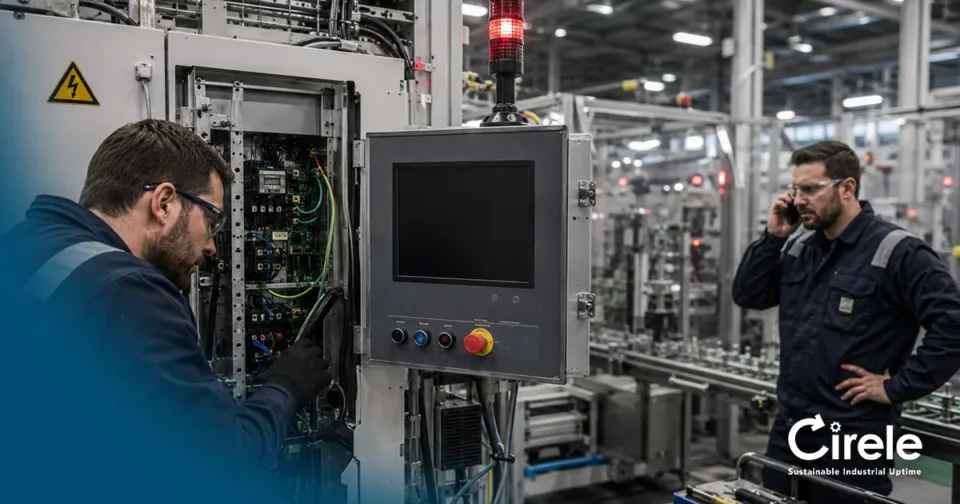
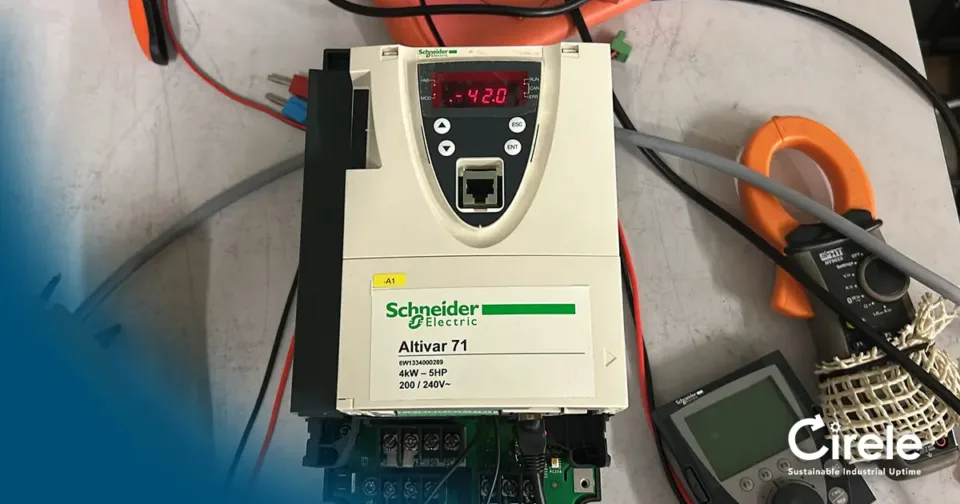
A faulty variable frequency drive can immediately cause production downtime. The motor no longer starts, the machine stops during operation, fuses trip, or the drive shows a fault code such as overcurrent, earth fault, DC bus fault, undervoltage or overvoltage. For a maintenance team, the most important question is: is the problem really inside the VFD, or is the fault caused by the motor, brake, motor cable, power supply or parameter settings?
Cirele repairs and supplies industrial electronics for factories, machine builders and maintenance departments. We support Siemens VFD repair, Lenze drive repair, Danfoss VLT repair, ABB ACS repair, servo drive repair, PLC repair, HMI repair and the supply of new, used and refurbished industrial automation parts.
In this article, we explain how to analyse a VFD fault, what common symptoms mean, and when repair, a refurbished replacement drive or a new alternative is the best solution.
Common Symptoms of a Faulty Variable Frequency Drive
A variable frequency drive fault often becomes visible through the behaviour of the machine. Not every fault means that the drive itself is defective, but the symptoms give an important direction for troubleshooting.
Common symptoms include:
- The VFD does not power up.
- The display remains dark.
- The motor does not start.
- The motor runs unevenly or erratically.
- The drive shows an overcurrent fault.
- The drive reports a DC bus fault.
- The VFD shows an earth fault or ground fault.
- Fuses or circuit breakers trip.
- The motor brake does not release.
- The machine trips when load is applied.
- There is a burning smell from the drive.
- The cooling fan does not run.
- Parameters are missing or incorrect.
- Communication with the PLC or fieldbus is lost.
Bij dit soort klachten is het belangrijk om niet alleen naar de frequentieregelaar te kijken, maar naar het complete aandrijfsysteem: voeding, drive, motor, rem, kabels, mechanische belasting en aansturing.
The Cause Is Not Always Inside the VFD
A fault code on the variable frequency drive does not automatically mean that the drive itself is defective. In many cases, the VFD detects the fault, but the root cause is somewhere else in the system.
1. Motor Insulation or Motor Damage
Poor motor insulation can cause earth faults, leakage currents or overcurrent trips. This is common in older motors, humid environments, heavy-duty applications or installations with damaged motor windings. A defective motor can repeatedly trip a fully functional VFD.
2. Motor Cable or Shielding Problems
Damaged motor cables, moisture inside cable glands, poor shielding or cable breaks can cause faults that look like a defective VFD. These issues may result in earth faults, irregular motor behaviour, EMC problems or trips during acceleration.
3. Brake or Braking Resistor Issues
In hoisting, positioning, transport and lifting applications, the motor brake is critical. If the brake does not release, the motor is mechanically blocked and the VFD may show an overcurrent fault. A defective braking resistor or brake chopper can also cause DC bus faults or overvoltage trips.
4. Bearing Problems or Mechanical Overload
A seized bearing, blocked conveyor, contaminated pump or mechanical overload can increase motor current significantly. The drive may report an overcurrent fault, while the actual issue is mechanical.
5. Power Supply Problems
Voltage dips, phase loss, poor mains quality, loose terminals or ageing contactors can lead to unexplained AC drive faults. A drive can only operate reliably when the incoming power supply is stable and within specification.
6. Moisture, Dust and Contamination
Industrial drives often operate in harsh environments with dust, heat, vibration, oil, moisture or chemical contamination. This can lead to short circuits, poor cooling, corrosion, damaged PCBs or defective power components.
7. Incorrect Parameter Settings
After replacement, reset, power failure or commissioning work, drive parameters may be missing or incorrect. Important settings include motor power, motor current, motor type, encoder feedback, brake control, fieldbus communication, ramp times and control mode. A drive can be technically functional but still fail because of incorrect parameters.
Overcurrent storing frequentieregelaar: wat betekent dit?
An overcurrent fault means that the drive has detected excessive current. This can occur during power-up, enable, acceleration, normal operation, braking or under load.
Possible causes include:
- Defective IGBT module inside the VFD.
- Short circuit in the motor.
- Mechanically blocked motor.
- Acceleration time set too short.
- Incorrect motor parameters.
- Brake not releasing.
- Moisture or contamination.
- Damaged output stage.
If the VFD overcurrent fault keeps returning, do not continue resetting the drive without investigation. If there is internal damage, such as a defective IGBT module, gate driver fault or shorted output stage, every restart attempt can increase the damage.
DC Bus Fault: Power Supply, Brake Chopper or Internal Drive Problem?
A DC bus fault is related to the internal DC link voltage of the variable frequency drive. Depending on the fault code, the issue may be undervoltage, overvoltage or instability in the DC bus.
Common causes include:
- Incoming voltage too low
- Phase loss.
- Defective rectifier.
- Ageing DC link capacitors.
- Defective brake chopper.
- Broken or incorrectly connected braking resistor.
- Regenerative energy from the motor.
- Deceleration time set too short.
- Internal drive damage.
Older VFDs often suffer from ageing capacitors. The drive may still power up, but fail under load, during start-up or during braking. In that case, VFD repair or preventive refurbishment can be a reliable solution.
IGBT defect in frequentieregelaar
One of the more serious faults in a VFD is an IGBT failure. IGBTs are the power components that control the motor outputs. When these components fail, the drive may trip fuses, show immediate overcurrent, fail to start or become completely dead.
Possible signs of IGBT failure include:
- Fuses trip immediately after power-up.
- Drive shows instant overcurrent.
- Motor hums or runs unevenly.
- Visible burn damage.
- Short circuit between output phases.
- Fault appears immediately after enable.
- Drive is completely dead after a hard fault.
An IGBT failure in a VFD requires specialist repair and proper functional testing. Replacing only the damaged component is not enough. The root cause must also be checked, including gate drivers, power supply circuits, PCB damage, current measurement, capacitors and thermal stress.
Wat kan de technische dienst veilig controleren?
Before removing or sending in the variable frequency drive, the maintenance team can perform several checks. These should only be carried out by qualified personnel and according to the applicable safety procedures.
1. Check the Incoming Power Supply
Verify that the correct supply voltage is present and that all phases are available. Also check whether voltage drops occur during start-up or under load.
2. Record the Exact Fault Code
Write down the exact fault code and description. Also note when the fault occurs: during power-up, after enable, during acceleration, under load, during braking or randomly during production.
3. Photograph the Nameplate
Take clear photos of the brand, article number, type code, serial number and installed options. For brands such as Siemens, Lenze, Danfoss and ABB, the exact part number is essential for assessing repair or replacement options.
4. Check the Motor and Motor Cable
Look for visible cable damage, loose connections, damaged glands, moisture or signs of overheating. If required, an insulation test may be necessary. Always follow manufacturer instructions and internal electrical safety rules.
5. Check the Motor Brake
For motors with a brake, check whether brake voltage is present and whether the brake mechanically releases. A stuck brake can produce the same symptoms as a defective drive.
6. Check Cooling and Contamination
Inspect cooling fans, air channels and filters. Overheating caused by dust or blocked ventilation is a common cause of VFD failure.
7. Secure the Parameters
If possible, create a parameter backup. Parameter transfer can be critical when repairing or replacing a drive, especially in older machines or applications without available documentation.
When Should You Stop Resetting the Drive?
In production environments, it is common to reset a VFD several times in the hope that the machine will start again. This is understandable when there is production pressure, but it can also make the damage worse.
Stop resetting the drive when there is:
- Repeated overcurrent fault.
- Burning smell.
- Smoke.
- Tripping fuses.
- Visible burn damage.
- Moisture inside the drive.
- Fout direct na inschakelen.
- Hard short circuit.
- Unknown cause after several reset attempts.
Continuing to reset a faulty drive can turn a repairable fault into severe PCB damage, destroyed power modules or additional damage to the motor and cables.
VFD Repair
With VFD repair, your own drive is inspected, repaired and tested. This is especially useful when the part is difficult to source, when the machine depends on specific parameters, or when the equipment is obsolete but still critical for production.
Cirele repairs variable frequency drives and AC drives from brands including:
- Siemens
- Lenze
- Danfoss
- ABB
- Schneider Electric
- SEW
- Omron
- Yaskawa
- Bosch Rexroth
- Control Techniques
During repair, we do not only look at the failed component. We also inspect wear-sensitive parts such as capacitors, fans, relays, solder joints, power supplies and power semiconductors. Where necessary, weak or ageing components are replaced preventively.
Refurbished Replacement Drive or Exchange Unit
When production is down, waiting for a repair may not always be possible. In that case, a refurbished VFD, replacement AC drive or exchange unit can be the fastest solution.
A refurbished replacement drive is often suitable when:
- Production must restart quickly.
- The exact same part number is required.
- New delivery is unavailable or too slow.
- The drive is end-of-life or obsolete.
- The defective unit can be repaired later as a spare.
- Parameter transfer is possible.
Cirele can help determine whether repairing your own drive, supplying a refurbished replacement or selecting a new alternative is the best option.
New Alternative or Retrofit
Sometimes repair or refurbished replacement is not the best long-term choice. For example, when the drive has recurring failures, when the machine is being modernised, or when the old model is no longer reliably available.
A new alternative or retrofit may be suitable when:
- The drive is no longer economical to repair.
- Several drives in the same production line are ageing.
- Communication or safety functions need to be updated.
- Spare parts are no longer available.
- The customer wants to standardise preventively.
However, a new drive is not always plug-and-play. Parameters, motor data, brake functions, communication, I/O, encoder feedback and PLC control must be configured correctly. That is why technical assessment before replacement is important.
Siemens, Lenze, Danfoss and ABB VFD Repair
Many maintenance departments search by brand, series or part number. This makes sense, because every manufacturer uses its own fault codes, parameter structure and article number format.
Common search queries include:
- Siemens VFD repair
- Siemens SINAMICS repair
- Lenze drive repair
- Lenze 8200 repair / Lenze 9300 repair
- Danfoss VLT repair
- ABB ACS repair
- Variable frequency drive repair
- AC drive repair service
Cirele supports maintenance teams, machine builders and industrial companies with repair, supply and technical assessment of industrial drives. We also help with older, hard-to-find and end-of-life components.
For a fast quotation or technical assessment, please provide as much information as possible.
For a fast quotation or technical assessment, please provide as much information as possible.
Ideally, send us:
- Brand.
- Article number.
- Type code.
- Serial number.
- Fault code.
- Short fault description.
- Photo of the nameplate.
- Photo of the display or visible damage.
- Machine or application informatio
- Whether production is currently down.
- Whether parameters or backups are available.
The more complete the information, the faster we can assess whether repair, refurbished supply or new replacement is the best solution.
Production Down Because of a Faulty VFD?
A faulty variable frequency drive can have a major impact on production, planning and delivery reliability. Speed matters, but choosing the right solution is just as important. Sometimes VFD repair is the best option. Sometimes a refurbished replacement drive is faster. In other cases, a new drive or retrofit is the most reliable long-term solution.
Cirele helps maintenance departments, technical services and machine builders with the repair, testing and supply of industrial electronics. We focus on getting your machine running again as quickly and reliably as possible.
Production down because of a faulty drive? Contact Cirele for urgent VFD repair or a replacement module.
Send us the brand, article number and a short fault description. We will assess whether repair, refurbished supply or new replacement is the best solution.